The practical guide
Pōhutu geyser at night: what to expect
How often Pōhutu erupts, why nobody can give you a timetable, how the Te Pō evening runs, what to wear, and how to get to Te Puia and back.
See Te Pō tickets on GetYourGuide ↗Quick answer
Pōhutu erupts up to 20 times a day, but not to a timetable, so a Te Pō walk gives you a fair chance of seeing it, not a promise. The evening runs about two and a half hours: performance first, then the geyser walk with hot chocolate, then a hāngī buffet. Wear comfortable shoes and clothes for the weather. The booking lists no hotel pickup, so arrange your own way there and back.
Pōhutu at a glance
| Detail | |
|---|---|
| Height | Up to about 30 metres |
| Frequency | Up to 20 times a day |
| Each eruption | Typically 10 to 20 minutes |
| Where | Whakarewarewa Thermal Valley, Te Puia |
| Timetable | None; no guarantee |
Pōhutu in short
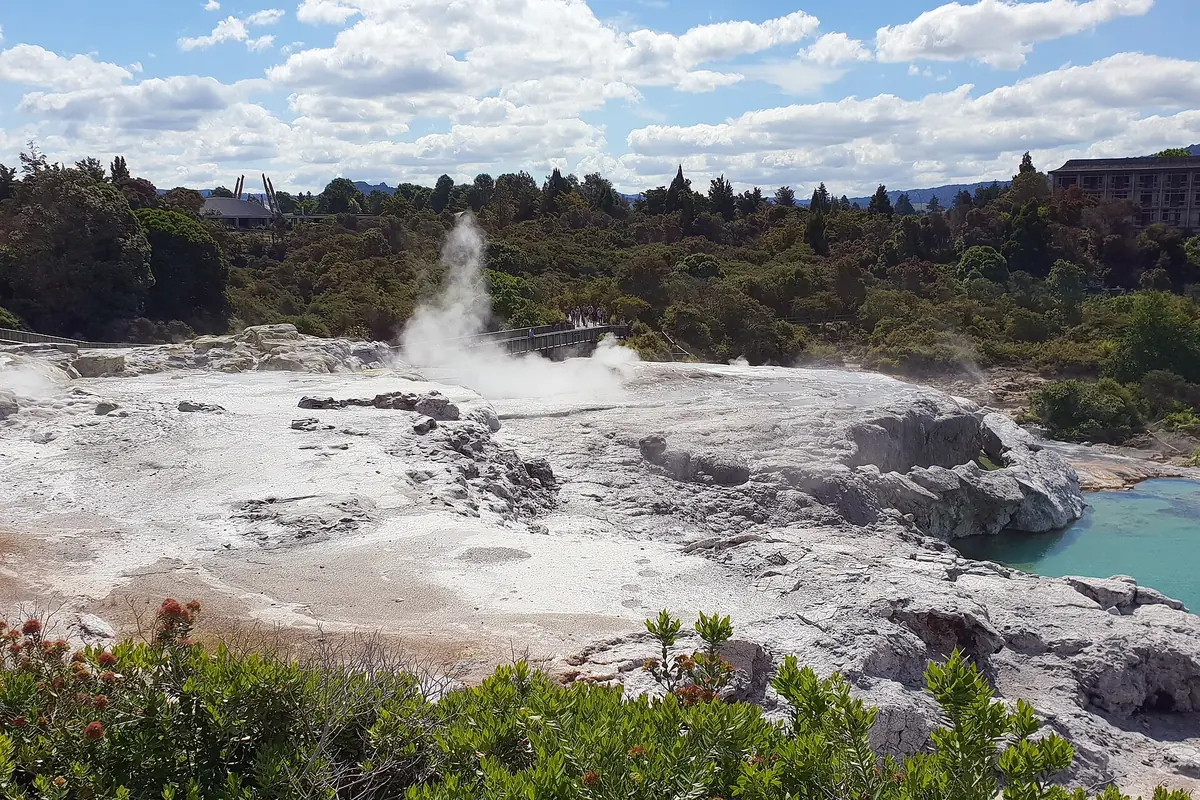
Pōhutu is the largest active geyser in the Southern Hemisphere. It sits in the Whakarewarewa Thermal Valley, inside Te Puia's grounds. It can reach about 30 metres, it erupts up to 20 times a day, and an eruption typically lasts 10 to 20 minutes. The name is translated as big splash, explosion or constant splashing, though its origin is unclear. On a Te Pō evening you walk down to it after the performance, with a cup of hot chocolate.
Why there is no eruption timetable
Nobody can give you reliable eruption times, and Te Puia says so: it cannot guarantee when Pōhutu erupts, though most visitors see it erupt during their visit. The Prince of Wales Feathers Geyser usually erupts before Pōhutu, which makes it a useful sign to watch for. Between eruptions you can still see steam rising from the terrace. Wikipedia gives the frequency as roughly hourly, while Te Puia says up to 20 a day; either way it is frequent but irregular. So the walk on Te Pō gives you a fair chance of an eruption, not a promise.
The valley around the geyser
Whakarewarewa is a geothermal area on the southern side of Rotorua with about 500 pools and at least 65 geyser vents, each with its own name, of which seven are currently active. Te Puia sits inside it. Wikipedia lists a second operator, Whakarewarewa Thermal Village Tours, that also runs visits in the valley, so check that the name on your booking says Te Puia. The Pōhutu you walk to on Te Pō is the best known feature, but it is one vent among many.
Why it erupts so often
Pōhutu's activity is partly the result of a decision about nearby wells. Drilling by Rotorua residents damaged geothermal features around the city. In 1987 and 1988 a programme cemented 106 wells within 1.5 km of the geyser, and the geysers and springs have since recovered noticeably. Some scientists worry that increasingly regular eruptions could in time cause the system to die out. That is a long-term question, not something that changes your evening.
How the night is laid out
Te Pō runs about two and a half hours. You check in at Reception, and Te Puia asks visitors to arrive 15 minutes before their booked time. The performance in Te Aronui a Rua comes first. Next is the walk to the geyser with hot chocolate. The hāngī buffet dinner at Pātaka Kai Restaurant & Bar comes last. Your host speaks English. Te Puia's own terms say a late arrival can forfeit the ticket, with a possible rebooking on a later evening if there is space. The booking calendar shows the start time for your date; this guide gives none, because the sources differ.
Read next: Te Pō vs Te Pā Tū vs Mitai: which to book
What you see and hear
The performance is kapa haka, the term for Māori action songs and the groups who perform them. A performance can include choral singing, haka, poi and mōteatea, an old-style chant. The song poetry is in Māori, so you follow much of it by sight and through your host. In haka you may see pūkana, wide-eyed expressions, and vigorous movements such as slapping the body. The evening opens with a pōhiri, a formal welcome, and haka are performed to welcome guests as well as to mark occasions.
What to wear and bring
Bring comfortable shoes and clothing suited to the weather. The performance is indoors, but the walk to the geyser is outdoors. For its own night walk, Te Puia advises dressing for cooler weather, since it is cooler at night, and says it operates in rain or shine. Ponchos are sold on site. No dress code is published for Te Pō, so a layer and shoes you can walk in are the sensible choice.
Children, access and dietary needs
The booking is suitable for all ages, and infants under 4 can enter for free. It is listed as wheelchair accessible; tell the operator when you book if you need assistance. Te Puia says its valley is wheelchair accessible, lends wheelchairs free at the ticketing office and has accessible toilets, including at the restaurant. New Zealand Sign Language translation is not currently available. Vegetarian and gluten-free options are available for dinner; say what you need when you book. The minimum drinking age is 18. Parents should weigh the length of the evening against bedtimes, and carers travelling with a guest who needs assistance may be eligible for a discount, which you arrange with Te Puia directly.
Getting there and back
Te Puia is on Hemo Road at the southern end of Rotorua, with free parking on site. This booking lists no hotel pickup, so arrange your own way. Te Puia's FAQ lists rideshare, taxis and a city bus; the bus stops running in the early evening, so it will not bring you home after Te Pō. From further away, State Highway 5 is the main road from Hamilton and Auckland, and Air New Zealand flies to Rotorua daily from Auckland, Wellington and Christchurch. Plan to sleep in Rotorua that night.
If you want more of the valley
Te Puia runs daytime guided tours of the valley, covering the geothermal valley, the Kiwi Conservation Centre and the New Zealand Māori Arts and Crafts Institute; the Te Rā tour takes about 90 minutes. It also runs Mārama: Geyser Light Trail, a hosted night walk past interactive artworks to heated terraces overlooking Pōhutu. The walk is about 1.5 km and takes an estimated hour, it runs in all weather, and you go at your own pace. Mārama is a separate booking from Te Pō. Te Pō's geyser stroll is one stop in the evening, not a tour of the whole valley.
Who this isn't for
If you need to see Pōhutu erupt, no booking can promise it. If you want hours on the terraces, a daytime tour or Mārama gives you more time in the valley. If you want hotel pickup built in, this Te Pō booking does not list it. If you need sign language translation, Te Puia says it is not currently available. If you need the night to fit a fixed clock time, check the calendar before planning anything else around it.
Frequently asked questions
When does Pōhutu erupt?
Up to 20 times a day, but not on a fixed timetable. Te Puia says it cannot guarantee eruption times, and most visitors see it erupt during their visit. Eruptions typically last 10 to 20 minutes.
How high is Pōhutu?
Up to about 30 metres. It is the largest active geyser in the Southern Hemisphere, and it sits inside Te Puia's grounds in the Whakarewarewa Thermal Valley.
How long is the Te Pō evening?
About two and a half hours. The booking calendar and your confirmation show the start time for your date.
What should I wear?
Comfortable shoes and clothing for the weather. The geyser walk is outdoors, and Te Puia advises dressing for cooler weather at night.
Is Te Pō wheelchair accessible?
The booking is listed as wheelchair accessible; tell the operator when you book if you need assistance. Te Puia says its valley is wheelchair accessible and lends wheelchairs free at the ticketing office.
How do I get to Te Puia for Te Pō?
Drive (free parking on site), or take a rideshare or taxi. The booking lists no hotel pickup, and the city bus on Te Puia's FAQ stops early in the evening.
Sources